27 June 2012

Flavour of the Week: Tonka Beans


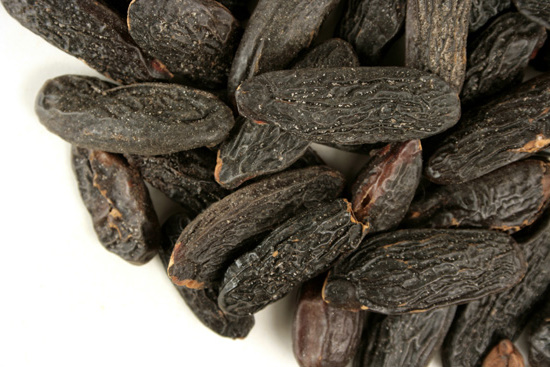
The flavour of the week comes from the  "cumaru" or "kumaru", species of tree that is native to northern South America and the Brazilian rainforest. Its seeds are known as Tonka Beans. Their appearance is black and wrinkled with a smooth brown interior. Their fragrance and flavour is delicious; redolent of vanilla, cinnamon, cherries, and cloves. Tonka Beans can be used in food, cocktails, perfumery, and to flavour candies and chocolates. Tonka beans are most often grated to release their aroma and flavour.
The Tonka seed contains the chemical coumarin, which is responsible for its sweet aroma and flavour but also has been shown to create liver toxicity in lab rats. The chemical occurs in small amounts in the plant, however, and has not been shown to cause any damage in humans. Because of these inconclusive studies the ingredient is banned in many countries, including the USA. France however, is wild for the stuff, and uses it in everything from desserts to cocktails to flavouring tobacco.
Tonka Beans also have enjoyed a long history as a medicinal ingredient in the Amazon. They are purported to be effective in treating cough, colds, asthma, snakebites, and have been used as an antispasmodic. It is also purported to be an aphrodisiac.  Kumaru trees can live to be over 1,000 years old.

26 June 2012

Markus Blattner: Zurich's Own Whisky Master


The Widder Bar in Zurich is a world class bar and would be remarkable in any of the more cosmopolitan cities on the globe. In the utterly charming, (if small and not quite totally cocktail savvy), city of Zurich, Switzerland, it is a revelation. Boasting over 1000 bottles of fine spirits and a dizzyingly long and comprehensive cocktail list, this old school bar has hosted some of the finest jazz musicians in Europe. But there’s more. Markus Blattner, the bar manager for over 12 years has a passion for and knowledge of whiskies that is truly remarkable. There are over 250 bottles of rare single malts lining the library-like shelves of the back bar. And he knows about each one. A lot about each one, in fact, since most of them he has researched and bought at auction himself. Here Markus shares a bit about his passion for whisky, bartending, and some excellent advice for new bartenders starting out in the careers.


How long have you worked at your bar?

Close to 14 years now. I started my career as a “commis de bar” and waiter at the Widder Bar in 1996. Then from 1998 till 2000 I worked on cruise liners as bartender/bar manager. Mostly on expedition liners from the Arctic to Antarctica. Late 2000 I got the job offer as “chef de bar” or bar manager at the Widder Bar. I’ve been here ever since.

How do you go about finding all your rare whiskies?

Like a hunter. Mostly while travelling and of course through the internet and industry publications such as whisky mag, mixology mag, class mag….and by talking to my dear customers.

What was the first drink/spirit you ever tasted and what was your reaction?

I can’t hardly remember. Probably the hidden sips of my father’s brandy and coke when he wasn’t looking. But it was really more about the Coke which was always a treat since we only had it once or twice a week! I soon then discovered beer which was obviously a drink which didn’t harm you too much and widely accepted even in younger years.

What is the first cocktail you ever made?

You really don’t want to know. But it was definitely with some Dutch sweet coloured liqueur.  

What was the first drink/spirit you really fell in love with and why?

Whisky and Rum. Balvenie 12 year old Double Wood opened my heart for whiskies. The smooth delicate slightly honeyish and sweet character impressed me and still does. Even after having tasted probably more than a thousand whiskies still always a great dram. Rum at the beginning of my career but rather as mixer but after a hardcore period of Rum and Coke I neglected this spirit for a while.

What is a whisky that you have discovered recently that people might not know about?

The Nikka 70th anniversary selection, a limited collection of a Yoichi 12years, a Miyagikyo 12years, a Coffey still grain whisky 12years and a 12 year old blended whisky of the three. All of them at cask strength 58%. A superb quartet and a very interesting ideology. Further and the longer the more old blended Scotch whiskies preferably from the 50th, 60th, as an White Heather 5years from the 60th (can’t get any better!!!). An unfortunately or luckily unknown and in the whisky branch never mentioned Italian independent bottling company –
Samaroli./Moon. Their bottlings till 2000 were and still are, outstanding.

Do you see the bar scene in Switzerland changing in the next couple of years?

I hope so! There are a few geeks. The Swiss bar scene suffers a little bit from lack of attention since there are not too many attractions as in other major cities. Having the choice between London, Paris, Berlin, Vienna ….understandable. Nevertheless Zurich and Switzerland in general is a great place to live and spend a few days on your way to….!


If you were to have a conversation with a particular whisky (and presuming it could talk back and tell you its past) what would it be?

I would be probably more interested about its future. Being kept away for decades and just letting the angels share your soul is quite lofty, but maybe kept away after that for another decade in a collector’s cupboard doesn’t sound really exciting. Not letting people taste your body and soul and not to be able to reveal your innermost being seems extremely sad.


If you could pass just one thing on to a young bartender what would it be?

“Carpe Diem”, life is not always about being a mixologist. And not everybody is supposed to be a bartender. It’s far more important that you find what you really love to do. And then it doesn’t matter where and what you are. As a mentor I always try to push my young employees to question themselves. Until they are thirty the world is open and they should try as much as possible to find what they were looking for before deciding.

Do you have any crazy stories from whisky auctions you care to share?

There are not too many stories on auctions since I always bid on the internet. But buying a totally unknown old bottle of anything for nothing is thrilling. You never know what you get. But it is by far one of the most interesting things I’ve ever done and will ever do.

What’s the best whisky to have with fondue?

Presumably a Laphroaig 10years old, a Bruichladdich X4 Quadruple (new spirit) or and probably even better a new spirit of any whisky.

You can find Markus behind the bar most nights at The Widder. Do yourself a favour and if you decide to have a whiskey, ask for a recommendation. This fellow knows what he is talking about.
http://www.widderhotel.ch/widder-bar/index.html?seo=1

15 June 2012


What is exactly is terroir? It’s a word that you might have heard thrown about out of the mouths of your oenophile friends. Maybe a sommelier insisted that this Mosel Riesling had an excellent sense of terroir, and that’s why you ended up drinking a wine that tasted like eating peaches on a tire swing in the dead of summer, suspended above a dazzlingly white flint quarry. Maybe you thought it was someone mispronouncing the word terrier…Well, what is terrior, exactly?
Terroir, from the French word terre, meaning "land" is the special characteristics that the geography, geology and climate of a certain place bestow upon particular thing made in that region, such as wine. It can be very loosely translated as "a sense of place," which is embodied in the certain characteristic qualities that things like soil and mineral composition have on something like a wine. The concept of terroir is at the base of the French wine system, appellation d'origine contrôlée(AOC) that has been the model for appellation and wine laws across the globe. At its core is the assumption that the land from which the grapes are grown imparts a unique quality that is specific to that region. So what does that mean?
It means a wine grown on chalky soils will taste different than a wine grown on slate. Limestone will give a different set of characteristics than basalt. Though the reason for this is not yet totally understood, it is widely accepted that when the vines bring up nutrients from the soil they bring infinitesimal particles of the minerals and soil up the root systems, into the fruit, and ultimately into your glass. That’s why you can taste scorched earth in a good Coté Rotie.  It literally means, “Roasted Slope”, and the impression of the sun-drenched soil the grapes are grown in can be sensed in your glass.  Kimmeridgian clay, an ancient seabed that now forms the soil under some of the most celebrated vineyard sites in the world, (Burgundy and Champagne, to name two), is a limestone heavy with nutrients from the fossils of shellfish from eons ago. A great deal of the complex characteristics of these wines is attributed to the soil they are grown in.
 You can’t really make a world-class wine without something intriguing going on under the ground. Terroir- in so many words, is that intrigue.
For some considerable time at Drinkfactory, the word terroir has become synonymous with obsession.
“ Terroir, and how to give the impression of terroir, of sensations normally only associated with wine, has really occupying us at the lab for a while now.” said Tony Conigliaro. “I’m interested in terroir- things like flint, clay, chalk, and different types of soils, because very clearly we can identify when they are present- say in wine- but we can’t necessarily actually register them as tastes. There is no such thing as a definable flavour of flint, but we have made the most incredible flint vodka using flint stones in the Rotovapor. When you taste it there is an incredible sensation, almost like licking a wet stone.  The flavour is there, but it’s actually not, and believe it or not the sensation is actually quite pleasant. Working from that point we have started to experiment with other things, like clay to see what effects they bring with them when treated in various ways in the lab. Some of the effects are stunning.”
He then continued, “ Our goal in this is to bring a lot of the complexity you find in really good wines and apply it to cocktails. It already works well in our pink peppercorn and flint vodka drink (The Sirocco, a drink that has been on the 69 menu for about a year), but we just want to push the envelope and see what else we can do. We’ve been given soil samples from Champagne houses and we’ve been playing around with that. Different types of rocks, soil, you name it- we’ve tasted it. Imagine something that tastes like wine, but has no wine in it. Wouldn’t that be crazy?”
He chuckles, “Well you can see why we all are a little obsessed around here right now.”
Make sure to look back to the blog to find out what the lab is doing next regarding terroir. For now pour yourself a glass of Chablis and see if you can taste the limestone. Then get prepared to do the same with a cocktail sometime soon.

13 June 2012

Flavour of the Week


Mabolo, more Commonly known as Velvet Apple
is a plant of the genus of ebony trees and closely related to persimmons. The Velvet Apple is an edible fruit that has a skin covered in a fine, velvety fur which is usually reddish-brown, and soft, creamy, pink flesh, with a taste and aroma strangely akin to fruit cream cheese, with underpinnings of apples and bananas. The aroma of the outside of the fruit is unpleasant, most often compared to rotten cheese or cat feces. In fact, in French speaking islands where it grows it is known by names like the "Caca de Chat"- literally, “Cat Shit”. It is native to the Philippines, where kamagong usually refers to the entire tree, and mabolo is applied to the fruit. Velvet apple trees are rarely found in Sri Lanka too.
Fun Fact! True ebony wood comes from trees like the Velvet Apple, which is used in fine musical instrument parts like violin fingerboards, tailpieces and chinrests.

Calling all US Bartenders! If you are going to be at Tales of the Cocktail in New Orleans this July then you must enter the Merlet Spirits Sidecar Cocktail Competition. Five finalists will compete for a trip to Cognac to learn how to make Cognac with the Merlet family, then spend 2 days in lovely Paris, France! All the details are on the fliers above. Bonne Chance!

06 June 2012

Milk, Food Colouring, and Soap Experiment

Drink Factory would like to present an incredible video illustrating the effect of surface tension changes and turbulence as illustrated by 3 simple things: milk, dish soap, and food colouring.  When the dish soap comes into contact with the milk and food colouring it causes the colours to swirl and creates fantastic movement and patterns.
So what exactly is happening here?
Milk is mostly water but it also contains vitamins, minerals, proteins, and tiny droplets of fat suspended in solution. Fats and proteins are sensitive to changes in the surrounding solution (the milk).
When you add soap, the weak chemical bonds that hold the proteins in solution are altered. The molecules of protein and fat bend, roll, twist, and contort in all directions. The food colour molecules are bumped and shoved everywhere along with them, providing an easy way to observe all the invisible activity. At the same time, soap molecules combine to form a micelle, or cluster of soap molecules. These micelles distribute the fat in the milk. This rapidly mixing fat and soap causes swirling and churning where a micelle meets a fat droplet. When there are micelles and fat droplets everywhere the motion stops.

The other thing that is happening is the disruption of surface tension. Since milk is mostly water, it has surface tension like water. The drops of food colouring floating on the surface tend to stay put on top of the surface tension. Liquid soap wrecks the surface tension by breaking the cohesive bonds between water molecules and allowing the colours to zing throughout the milk.

Though a drink made with dish soap isn’t a real possibility it is interesting to think of utilizing a process similar to this with drinks in the future. Imagine being served a drink with another secret ingredient on the side. When you drop it into your drink it becomes a colour explosion!
http://www.youtube.com/watch?v=hPFwDaR1g70

31 May 2012

Flavour of the Week


Chamomile, Roman

Roman chamomile is an herbaceous perennial native to western Europe and North Africa. Chamomile flowers contain anti-inflammatory and sedative ingredients and have been used in medicinally for centuries.
The word derives, via French and Latin, from Greek χαμαίμηλον (chamaimilon) ("earth apple"), which is evocative of one of the aromas of the plant.

Interestingly, even though chamomile flowers are white and yellow, when distilled the chamomile oil turns a dark blue. This is due to a naturally occurring chemical, named sesquiterpenoid chamazulene (C14H16) [6] [86].

In aromatherapy the essential oil is considered in general to be calming, rejuvenating, and relaxing.  The scent is hard to pin down and has been described as woody, peachy, prune-like, soapy and sweet. The flavour can be described as sweet and somewhat heady. It is most commonly used in a tisane, or tea, but it can also be found in powdered form. Chamomile in cocktails lends a delicate sweetness and floral note.


14 May 2012

Stages Program Returns at Drink Factory / 69 Colebrooke Row


Drink Factory and The Bar with no Name at 69 Colebrooke Row are very pleased to announce our 2012 Stages program is now open for applications.  

Positions will be open to all, though an interest in cocktails, food science, flavour and perfume are inherent.  

The Stages program offers a unique period of time to work alongside Tony C and the award winning team of 69 Colebrooke Row and the Drink Factory. You will be aiding the everyday running of the Drink Factory, as well as shadowing ongoing research and development, gaining an exclusive insight into this unique setting.

Apprentices will not only be trained on the happenings and equipment within the lab, they will also get the opportunity to see these realized within the bar environment. This will provide a rare view of the unique process of concept formation, development and implication of ideas.

The position will provide a rare opportunity to learn from leaders in the field of cocktail science, be involved in pioneering projects, and will help the understudies develop a unique set of skills and gain invaluable experience.

Apprenticeship duration will last one week and will run on set dates outlined within the attached application form.  Applicants must complete the application form, provide two references, and be prepared to be called for interview.  Unfortunately we are unable to provide accommodation for successful apprentices.

Completed forms should be returned via email to zoe@69colebrookerow.com Please note that only successful applicants will be contacted. 

The deadline for completed and returned forms is Thursday 31st May.    

You can download the application by clicking HERE 


69 Colerooke Row 3rd Birthday


We are very pleased to announce our third birthday celebrations are now planned and ready to go. The event will take place on Sunday June 3rd. It will be a very special affair with the promise of surprises throughout the night.

11 May 2012

Societe Perrier Interview Tony C


The newest Luminary of Societe Perrier, Tony C, took the time to sit down and have a chat with Karen Loftus to answer questions that include what he thinks will be the next big trend, how aromatics will grow in use throughout the cocktail world and what is Tony's greatest creation to date. 

I love your sensorial approach to creating cocktails, which is often affiliated with molecular mixology. Why is it that you don't want to be affiliated with that term?

Tony Conigliaro: It’s a term that has limiting implications. We work with a far wider inter-disciplinary outlook as we take on projects with designers, perfumers, chocolatiers, and architects to name but a few. To use that term implies we look at things purely through the lens of science, which is simply not always the case.

The minute you start defining things as this style or that style they become dead museum pieces. We are far more creatively dynamic than that. We are always moving, discovering beyond what we have already done and what is already out there by not following trends or styles - unless we are subverting them!

What is your greatest cocktail creation? 

The Prairie Oyster is one of my all-time favorites. It was when the worlds of science, bartending and culinary skill collided for a moment. It’s a concept drink on many levels, from .......

You can read the full interview HERE


09 May 2012

Perfume and Poetry


As scent and perfume continues to make long and swift bounds firmly into  the world of art and sensory experience, we now start to wonder how the idea of scent and poetry can inspire one another. 

The event comes from the minds of Claire Trevien and Odette Toilette who has been running the Scratch & Sniff events in East London for a while to broadly critical acclaim. The evening is called Penning Perfume and takes the shape of an ongoing project between poets and perfumers who endeavour to explore each others worlds and find inspirations through each others craft. The process will culminate June 12th at The Book Club in a Read & Sniff event. 

Trevien had this to say on the idea…

"I feel like smell is neglected in poetry – it's used quite lazily and people feel illiterate when it comes to smell. It's a challenge for poets to learn to smell," 

A dozen poets were given anonymous scents which they were asked to smell and create a poem based on the scent. At the same time six perfumers were asked to create a scent inspired by an anonymous poem they were given. 

One such pairing was Penny Williams (Orchadia) who was paired with poet Davib Morley. They had this to say on the process…

"When the poem was first read to me, in my 'mind's nose' my initial odour reflexes did not make a nice smell!" says Williams. "I've spent more time getting to know the poem and am developing a perfume that captures its essence."2

You can see more information on the evening HERE

The Post Imperial Shaker


It's been an interesting point of conversation for a while now, especially considering the incredible speed more and more innovative and accessible technologies are reaching the average bar, either pre or during service. So when will we see an end to a human bartender physically shaking a cocktail in favour of a automated mechanism…..if ever? 


There have been occurrences along the way, including paint mixers, and a bubble tea shaking machine that can be hacked for alcoholic use pretty easily. However, the most recent sightings embraces the idea but goes about it a very old fashioned way. 


It is called "The Post-Imperial Shaker" and is something you'd imagine to see equally at a steam fair and a vintage fashion show. It is based on a machine made at the turn-of-the-19th century called an "Imperial Shaker" and was originally built to be part of The Touring Pop-up Sideshow Saloon

The original "Imperial Shaker" appears amongst other illustrations in the book Recipes of American and Other Iced Drinks.


The technical side of things is explained below…

"Technically, this machine uses a flywheel driven by a hand-crank, which pushes a 'crank-slider,' or pivoting piston. At the end of the crank-slider is a carriage where two cocktail shakers live. The elliptical motion produced by the crank-slider lends itself to mixing cocktails, where a simple up/down motion would not stir the ingredients as much."


The argument really boils down to a time and a place. For many customers the "Shake" is as much part of the show and attraction as the actual drink itself. It also offers a chance for bartenders to show some of their personality and put their own spin on a time honoured tradition. 

The shaker machine, embraces a retrospective, and dare I say classier, side of bartending that is becoming more and more fashionable. One could easily make an argument that "The Post Imperial Shaker" is as much, if not more, of a spectacle as watching a man do the same job. I doubt many are expecting to see this in action behind many bars anytime soon, and the mechanical version even less so however the value and attraction for a specific event or place is obvious. 

WAAHH Quantum Sensations Alcohol Spray


Brought to us by the same mind who created Whif, which administered an instant shot of flavour, such as coffee or chocolate, with zero calories, and then followed by Whaf which was an ultrasonic system to mix different liquids to create a cloud of flavour. 

Mr David Edwards has now done something potentially event more brilliant an invented a spray which will get you drunk instantly but only for a few seconds. The impending hangover will never coming and apparently there are zero aftereffects. 


One dose is equivalent to 0.075ml of alcohol, and it is thanks to the way the liquid is administered into your mouth that you can be hangover free and sober in no time at all. Reports say that you will even get a thumbs up on a breathalyser. 

The obvious question is why wouldn't someone just administer the entire cartridge in quick succession and what would the effect be? Well, considered one drink hold between 40 and 60ml of alcohol it would take up to 1,000 sprays to reach the same effect of one drink. 


One cartridge is equivalent to 21 sprays and will run at the price of only  20 euros. 


Tony C named Luminary of Societe Perrier


Societe Perrier describes its Luminaries as being...


"Chosen from a select group of top influencers and culture tastemakers, our luminaries represent the Société Perrier lifestyle both in their work and everyday lives. Our luminaries work directly with our Société Perrier editors in helping shape the content we bring to you daily. Get to know them here on Société Perrier."


Tony joins the ranks that includes our friend The Cocktail Lovers, Joe McCanta and The Cultural Expose. Be sure to check the site for regular updates on whats coming up including Tony's first book "Drinks".